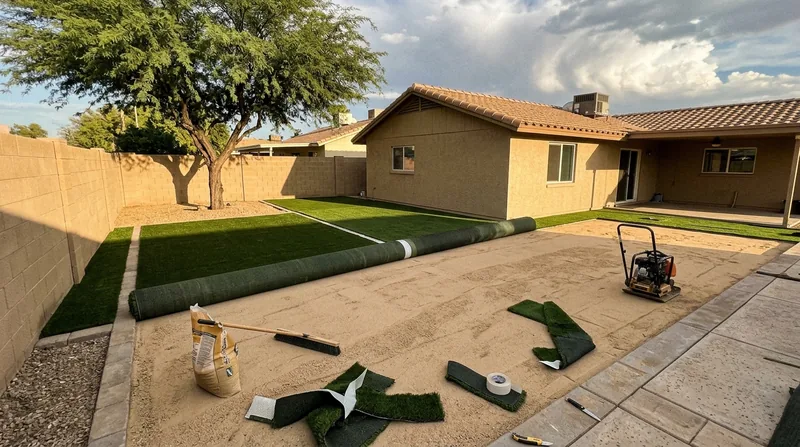




Residential Artificial Grass Installation in Tempe transforms the yards that suffer most in this climate: patchy bermuda lawns bleached by 115-degree heat, flood-irrigated basins that erode during monsoon season, and bare caliche that bakes hard between the block walls of Broadmor ranch homes and the newer family neighborhoods south of Tempe Town Lake. From the 1950s single-story homes near Arizona State University to the lakeside properties in south Tempe, homeowners face the same reality: a real lawn dies under the sun, irrigation water becomes expensive and wasteful, and the yard sits empty for half the year. Tempe Turf Installation removes the dead grass, builds a compacted decomposed granite base over the native clay, lays dense synthetic turf with perforated backing for monsoon runoff, and pins the edges tight along the tan stucco block walls that define the neighborhood. You get a yard that holds its color through summer afternoons, drains properly when the dust storms hit, and stays realistic year-round without the water bill or the dead patches.
Why Residential Artificial Grass Installation Matters in Tempe's Heat and Monsoon Climate
Tempe's terrain and weather create specific failures in real turf that artificial grass solves directly. The Salt River basin sits at 1,100 feet elevation with intense afternoon sun, alkaline caliche clay that sheds water, and summer monsoons that arrive with dust and heavy runoff. Bermuda lawns, the standard for Arizona yards, go dormant and brown by June, and keeping them alive through August costs water that Tempe homeowners are increasingly unwilling to spend. When monsoon rains come, bare soil washes away, leaving eroded patches and standing water that kills what grass remains. Block wall edges trap heat and dust, creating dead zones where nothing grows. Artificial turf eliminates these problems by design.
- Stays green and dense through 115-degree afternoons without irrigation, fertilizer, or seasonal dormancy.
- Drains monsoon runoff through perforated backing, preventing erosion and standing water in low spots.
- Eliminates the mow-and-blow cycle that raises dust during allergy season and fire weather.
- Holds its color and texture for 10 to 15 years with only occasional rinsing and brushing.
- Installs over compacted base that prevents the settling and washout common under heavy irrigation.
These advantages matter most in Tempe because the climate is not forgiving, and water is not cheap.
Key info: Tempe's HOA architectural committees commonly govern front-yard turf color, pile height, and edge treatment. We help homeowners prepare HOA submittals and work with your architectural rules, but we never promise approval. Check your CC&Rs before you call.
For more detail on how to evaluate turf options for your specific yard and climate, see our residential artificial grass comparison guide.
How We Install Residential Artificial Grass in Tempe: Step by Step
Every artificial turf installation in Tempe begins with a site walk and a written specification that names the turf product, face weight, pile height, infill type and pounds per square foot, and base depth and compaction. We do not lay 40-ounce turf on bare dirt and disappear. The base is the foundation: we excavate to remove old sod or dead patches, compact the existing clay with a plate compactor, lay 4 to 6 inches of compacted decomposed granite, and verify drainage. We request Arizona 811 utility locates before digging to mark buried power and gas lines. Irrigation lines, low-voltage landscape lighting, and pet fence wires are private lines that locates do not mark, so we work with you to identify and protect them. Turf is unrolled, seams are glued and taped, edges are pinned tight along block walls and hardscape, and the yard is raked to blend the infill and stand the pile upright. You receive the written spec, photos, and a one-year workmanship warranty on the installation.
- Site walk, photo documentation, and written spec naming turf product, face weight, pile height, infill, and base depth.
- Excavation and removal of dead grass, bare spots, or old turf; clay is compacted level.
- 4 to 6 inches of decomposed granite is spread and compacted to firm base.
- Arizona 811 locates mark buried utility lines; private lines (irrigation, lighting, pet fences) are identified and protected by the homeowner and us together.
- Turf is unrolled, seams are glued and taped, edges are pinned along block walls and hardscape.
- Infill is spread and raked; pile is brushed upright; yard is inspected and cleaned.
- Written spec and photos are delivered; warranty and care instructions are explained.
A typical Tempe residential yard of 400 to 600 square feet takes 2 to 3 days from base prep to finish.
Example: A 1950s ranch home in Broadmor with a 500-square-foot back yard and a 20-foot block wall on the south side: old bermuda is removed, clay is compacted, 5 inches of decomposed granite base is laid and compacted, perforated turf backing is unrolled, seams are sealed, and edges are pinned tight to the block wall. The north side of the yard, shaded by a mesquite tree, may not be suitable for turf, and we discuss that honestly before we bid.
If you have questions about how we handle specific site conditions, contact us for a free estimate.
Installation Methods and Base Preparation Approaches
| Approach | Description | Best for |
|---|---|---|
| Compacted Decomposed Granite Base | 4 to 6 inches of DG spread and compacted over native clay; perforated turf backing handles monsoon runoff. | Most Tempe residential yards; standard in alkaline clay soil with good drainage slope. |
| Stabilized Base with Crushed Stone | 3 to 4 inches of crushed limestone or Class II base compacted to prevent settling in areas with poor native drainage. | Low spots, yards with standing water after rain, or homes where the grade slopes toward the foundation. |
| Drainage Layer with Perforated Pipe | DG base plus french drain or perforated underdrain to channel monsoon runoff away from the yard and house. | Yards with chronic water problems, homes on a slope, or properties where grading change requires city approval. |
| Direct Install over Existing Hardscape | Turf is laid directly over concrete or pavers with a permeable underlayment; no excavation or base prep needed. | Patios, balconies, rooftops, or yards where the existing surface is level and stable. |
Every installation includes a site-specific assessment. If your yard has a drainage problem, we fix the drainage first or we do not proceed. If shade from a mesquite or palo verde tree makes turf a poor choice, we say so and suggest alternatives. That honesty is what separates a local independent turf installer from a brand dealer or a crew that lays turf on bare dirt and moves on.
Residential Artificial Grass Installation Cost in Tempe: What to Expect
Artificial grass installation in Tempe starts at approximately $8 per square foot for a straightforward residential yard with good access, level terrain, and no major site complications. A 400-square-foot back yard typically costs between $3,200 and $4,800 depending on turf quality, infill type, and base depth. A 1,000-square-foot yard ranges from $8,000 to $12,000 or more. Costs rise when the site requires extra base preparation (poor drainage, low spots, or unstable clay), when access is tight (narrow gates, alley delivery only, or multiple trips up stairs), when turf specifications call for premium materials (reinforced backing, cooling infill, or high face weight), or when sealing seams in high-traffic areas demands extra labor. HOA architectural rules may also require specific pile heights or colors that affect material cost. The only way to know your actual cost is to get a site estimate, and we recommend getting 2 to 3 estimates from different installers so you can compare the written specifications and the prices side by side. Our pricing guide breaks down typical costs by yard size and job complexity.
Never choose a turf installer based on price alone. A bid that is significantly lower than others often reflects skipped steps: thin base, low face weight, poor seam work, or no drainage plan. A written spec protects you because it names exactly what you are paying for and what you will get. Ask every installer for a detailed quote that includes turf product, face weight, pile height, infill type and pounds per square foot, base depth and compaction method, and labor. If an installer cannot or will not give you a written spec, move on.
What to Look for When Hiring a Turf Installation Company Near Tempe
Choosing the right turf installer is more important than the price you pay because the installation determines whether your yard drains properly, looks realistic, and lasts 10 to 15 years. When you interview installers near Tempe, ask these specific questions: Do you provide a written specification before the job starts that names the turf product, face weight, pile height, infill type and pounds per square foot, and base depth and compaction? Can you show references and photos of residential yards you installed in Tempe in the last two years? Will you request Arizona 811 utility locates and work with me to protect irrigation lines and pet fences? Do you have a certificate of insurance naming general liability and workers' compensation coverage? What is your workmanship warranty, and what does it cover? How do you handle drainage, and what happens if my yard has standing water after rain? If your HOA requires architectural approval, will you help me prepare the submittal? Get estimates from at least two installers, compare the written specs line by line, and ask each one to explain why their price is higher or lower than the others. The cheapest bid is often the riskiest. The best installer is the one who listens to your concerns, answers your questions directly, and stands behind the work with a written warranty and a local phone number.
For more information or to schedule a free estimate, contact Tempe Turf Installation at (520) 482-0822.
Residential Artificial Grass Installation in Tempe: Pricing Guide
| Service | Price | Details |
|---|---|---|
| Residential yard, 400-600 sq ft | Starting at $8/sq ft | Includes compacted DG base, standard turf, seams sealed, edges pinned, and one-year workmanship warranty |
| Residential yard, 600-1,000 sq ft | Starting at $8/sq ft | Cost per square foot may decrease with scale; total depends on turf grade, infill type, and site drainage complexity |
| Yards with drainage issues or poor access | On estimate | Extra base prep, french drains, or steep slopes require site walk to price accurately; drainage work may add $1,500 to $3,000 |
| HOA or architectural-compliance turf | Starting at $8/sq ft | Premium turf colors or pile heights may add 10 to 20 percent; HOA submittal preparation is included |
| Travel and site visit | Included | No mileage fee or call-out charge in Tempe and surrounding Maricopa County service areas |
| Free estimate | No cost, no obligation | Response within 24 hours at (520) 482-0822; written spec provided before any work begins |
Indicative pricing, the exact cost depends on square footage, finish, and site access. Free personalized estimate within 24h at (520) 482-0822.


