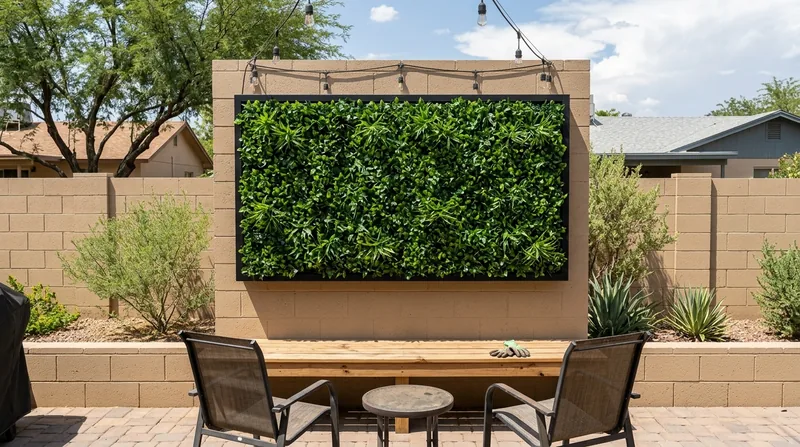




Tempe's downtown Mill Avenue patios, ASU-area courtyards, and mid-rise lobbies around Tempe Town Lake demand visual interest without the liability of a living wall. Artificial grass walls and vertical greenery deliver that polished, lush look year-round, even in 115-degree summers and monsoon dust storms. UV-rated synthetic panels frame cleanly against stucco block walls and modern steel, and they never brown out, drop leaves, or require drip irrigation in the Sonoran heat. Whether you're softening a blank courtyard wall, creating privacy screening on a Mill Avenue patio, or adding a feature wall to a downtown ASU venue, we design, frame, and install artificial turf installation systems that hold up to Arizona sun and deliver the maintenance-free aesthetic of a thriving living wall. This guide walks you through why vertical turf makes sense in Tempe, how the work gets done, what to expect in cost, and how to choose a turf installation company that gets the details right.
Why Artificial Grass Walls and Vertical Greenery Matter in Tempe's Urban and Residential Landscape
Tempe's dense mix of student rentals, downtown mid-rises, family neighborhoods, and ASU-area commercial venues creates constant demand for privacy, visual softening, and outdoor ambiance on tight footprints. Real climbing ivy and planted living walls struggle in full Phoenix sun, require weekly watering in summer, and often fail in the heat before monsoon season ends. Synthetic grass panels eliminate that cycle: they frame instantly, require no irrigation, no fertilizer, no pest management, and no replacement after a brutal season. They work on every wall exposure, from the south-facing courtyard wall that bakes all afternoon to the north-facing patio that stays in shade.
- Create privacy screening on rental patios and shared courtyards without drilling into HOA-controlled structures.
- Soften blank stucco block walls common to Tempe's 1950s-70s ranch and 1980s-90s family neighborhoods.
- Add visual interest to downtown lobbies, retail frontages, and restaurant patios without watering systems or dead-season downtime.
- Install on balconies, rooftop railings, and patio dividers where real plants cannot establish in containers.
- Maintain a lush, finished appearance year-round through 115-degree summers and dusty monsoon winds.
A well-designed artificial grass wall becomes a focal point and a practical solution to the Tempe heat in one frame.
Key info: Tempe's HOA rules often govern wall color, panel height, and edging on front-facing or common-area installations. We help prepare HOA submittals and understand the approval process, but architectural review is always the HOA's call. Contact your property manager or HOA board before scheduling an estimate if your wall is in a common area or governed by architectural rules.
How We Install Artificial Grass Walls in Tempe: Design, Frame, and Finish
Installation begins with site assessment and structural evaluation. We measure the wall, check sun exposure, confirm substrate condition (stucco, concrete, or wood), and determine whether the wall can support the weight of UV-rated panels and a backing frame. Most walls in Tempe are concrete block or stucco, which accept fastening cleanly. We then select turf product and pile height, design the frame layout to minimize seams and maximize visual impact, and schedule installation around weather and access.
- Inspect the wall for structural soundness, drainage, and sun orientation to select the right turf product and infill.
- Prepare the substrate by cleaning, repairing any cracks, and ensuring the surface is flat and stable.
- Install a backing frame (usually aluminum or pressure-treated wood) securely fastened to the wall to support panel weight.
- Cut and fit UV-rated synthetic grass panels to the frame, seaming edges with professional-grade adhesive and reinforcement tape.
- Finish seams, trim edges, and install any edging or trim pieces to blend the wall into the surrounding landscape.
- Test drainage and inspect the entire installation for color uniformity, seam quality, and structural integrity.
From design to final walk-through, a typical residential wall takes 1 to 3 days, depending on size and substrate condition.
Example: A Mill Avenue patio owner wanted privacy from a neighboring building and a softer aesthetic than a concrete or vinyl fence. We installed a 12-foot by 8-foot artificial grass wall with a realistic blended-green turf, seamed it seamlessly, and edged it with aluminum trim. The wall cost roughly $1,500 and took two days to frame and install. Six months later, it still looks new, requires no watering, and the owner has hosted dozens of gatherings without worrying about dust or dead plant material.
Installation Methods and Panel Options for Artificial Grass Walls
| Approach | Description | Best for |
|---|---|---|
| Framed Panel System | Aluminum or wood backing frame fastened to the wall; UV-rated turf panels cut and seamed to the frame; all edges trimmed and finished. | Residential patios, balconies, rooftops, and retail frontages where durability and clean lines are priorities. |
| Direct Adhesive Installation | Turf applied directly to a prepared concrete or stucco wall using commercial-grade outdoor adhesive; fastest method on flat, sound substrates. | Smooth concrete walls, stucco block, and interior courtyards where the wall is flat and moisture-controlled. |
| Modular Panel Tiles | Pre-made turf tiles (typically 24 inches by 24 inches or 12 inches by 12 inches) interlocked or fastened to a backing; easy to remove or replace individual tiles if damaged. | Rental properties, commercial installations, and walls where future access or modification is likely. |
| Ivy and Mixed-Pile Walls | Combination of grass turf and synthetic ivy panels for a layered, realistic living-wall appearance; higher visual impact but more seams to manage. | High-end patios, lobbies, restaurant exteriors, and ASU-area venues where the wall is a design focal point. |
Each method has trade-offs in cost, installation time, and long-term maintainability. We assess your wall, substrate, and goals and recommend the approach that delivers the best value and durability.
Artificial Grass Walls and Vertical Greenery Cost in Tempe: What to Expect
Cost for an artificial grass wall in Tempe typically ranges from $18 to $35 per square foot installed, depending on wall size, substrate condition, turf product choice, and installation method. A small 8-foot by 6-foot patio wall (48 square feet) might run $860 to $1,680 fully installed. A larger 20-foot by 10-foot courtyard wall (200 square feet) typically costs $3,600 to $7,000. The primary cost drivers are turf product quality (face weight and pile height), substrate preparation (repairs, cleaning, and leveling), framing materials, and seaming complexity.
Walls with existing stucco or concrete in good condition cost less to prepare than walls with cracks, moisture issues, or uneven surfaces. Ivy-and-grass combination walls cost more than single-turf installations because they require more seaming and precise color matching. A professional on-site estimate removes guesswork: we measure, assess substrate, discuss turf options, and provide a written scope and price. For comparison and detailed pricing breakdowns across all our services, visit our pricing page.
Artificial Grass Walls and Vertical Greenery Near Me: How to Choose a Turf Installation Company in Tempe
Choosing the right turf installation company matters because poor framing, cheap adhesive, or low-quality turf will show seams, fade, or fail within a season. Start by checking that the installer carries general liability and workers' compensation insurance and can provide a certificate naming both. Ask for a written specification that names the turf product, face weight, pile height, backing frame material, and adhesive type. Request references and photos of completed walls, especially walls installed more than one year ago, so you can see how the turf and seams have held up in Tempe sun and heat.
Verify that the installer understands local HOA rules if your wall is in a common area or governed by architectural guidelines. Ask whether they handle HOA submittals and approvals or whether that falls to you. Get at least two or three estimates before committing, and be skeptical of quotes that are significantly lower than others: that usually signals cheaper materials, less prep work, or inexperienced installation. A reputable local turf installer will take time to assess your wall, explain the work, and stand behind the finished product with a clear warranty on workmanship.
Ready to discuss your wall? Contact us for a free estimate or call (520) 482-0822. We serve Tempe, Central Tempe, and South Tempe, and we respond to all estimates within 24 hours with no obligation to book.
Artificial Grass Walls & Vertical Greenery in Tempe: Pricing Guide
| Service | Price | Details |
|---|---|---|
| Small residential wall (under 100 sq ft) | Starting at $18/sq ft | Framed or adhesive installation on sound concrete or stucco, standard grass turf, all seams finished and edged |
| Medium patio or courtyard wall (100-300 sq ft) | Starting at $22/sq ft | Substrate prep, backing frame installation, UV-rated turf, professional seaming, trim and edging included |
| Large commercial or mixed-material wall (300+ sq ft) | Starting at $25/sq ft | Complex framing, multiple turf types or ivy-and-grass combination, extensive seaming, structural reinforcement as needed |
| Substrate repair and preparation | Included or on estimate | If wall requires crack repair, moisture treatment, or significant surface leveling, site inspection determines the scope |
| Travel and site visit | Included | No separate mileage fee or travel charge for Tempe and surrounding areas, free on-site estimate within 24 hours |
| Estimate | Free | Detailed written proposal with product specs, labor, materials, timeline, and one-year workmanship warranty |
Indicative pricing, the exact cost depends on square footage, finish, and site access. Free personalized estimate within 24h at (520) 482-0822.


